The latest news, trends, analysis, interviews and podcasts from the global food and beverage industry

_gif.gif)
.jpg)


As food and beverage brands accelerate the move away from conventional plastics, compostable packaging is increasingly being positioned as a straightforward solution to mounting environmental and regulatory pressures. Yet when a new pack softens, leaks or fails in use, the material is often blamed. In reality, the problem is frequently less about whether compostable packaging works, and more about whether the right format has been matched to the product. With new packaging requirements coming into force and scrutiny of PFAS and environmental claims intensifying, Sameer Kulkarni, compliance and sustainability lead at Ecofy, explains how getting that specification right is becoming a commercial and compliance imperative.
A brand switches its hot-food container to a compostable version, and within weeks the complaints arrive: the base softens under a saucy dish, a lid warps, a chilled drink cup sweats and leaks. The usual conclusion is that 'compostable doesn't work.' Nearly always, the material was capable. It was simply matched to the wrong job.
That matters more in 2026 than it did even two years ago, because the switch is no longer optional. The EU's Packaging and Packaging Waste Regulation (Regulation (EU) 2025/40) came into force on 12 August 2026; in the United States, more than a dozen states have enacted restrictions on PFAS 'forever chemicals' in food packaging, with Maine's ban on nine categories of plant fibre food-contact packaging taking effect in May 2026. For food and beverage brands, compostable and PFAS-free packaging has moved from a marketing choice to a documented compliance requirement. Getting the specification right the first time is now a commercial issue as well as an environmental one.
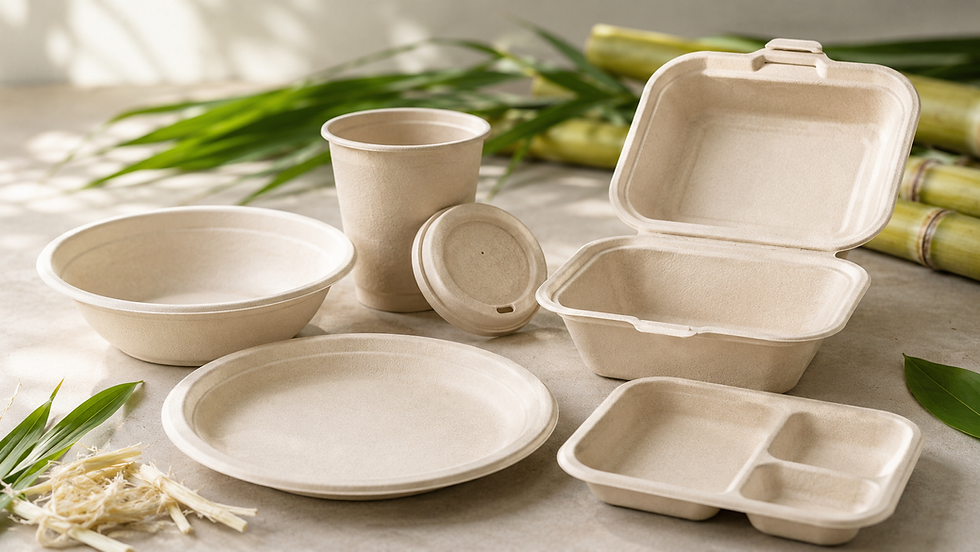
The first misconception to drop is that 'compostable' describes a single material. It is a category that includes moulded sugarcane fibre (bagasse), bamboo and wheat-straw pulp, PLA and CPLA and various coated and uncoated papers, each behaving very differently under heat, moisture, grease and time. Specifying 'the compostable option' without matching the format to the food is the root of most disappointing switches. From the production side, we see brands run into the same three mismatches again and again.
Each maps to a question worth asking before a switch, not after.
Does the material fit the food?
The variables that decide performance are temperature, moisture, fat content and dwell time – for example, how long the food sits in the pack before it is eaten.
A dry pastry and a hot biryani make entirely different demands. An uncoated fibre bowl that is perfect for a sandwich can fail under a curry left for twenty minutes; chilled and frozen lines add condensation; microwave reheating adds another stress.
The useful question is never 'is this compostable?' but 'will this format hold this food, at this temperature, for this long?'

Does the material fit the market?
A compostable product only delivers its benefit where the infrastructure to process it exists, and that infrastructure is uneven.
BioCycle's national survey found composting facilities accepting compostable packaging rising from 58% in 2018 to 71% more recently – real progress, but far from universal – while 45 of the 145 facilities surveyed run a zero-tolerance policy for contamination.
Industrial-compostable is also not the same as home-compostable. Ship an industrially compostable pack into a region without industrial composting and it behaves like ordinary waste, and the environmental claim quietly collapses.
Can you defend the claim?
This is where brands carry the most reputational and regulatory risk, and where the data is sobering.
When organisations Consumer Reports and The Counter, tested moulded fibre foodware, they found fluorine, an indicator of PFAS, in effectively every moulded fibre bowl tested, at levels several times higher than in many other packaging types.
A product can be genuinely compostable and still carry a fluorochemical coating that makes it neither safe nor truly compostable. 'Compostable' and 'PFAS-free' are separate properties that must be separately verified: the actual certificate and its scope (not a supplier's logo), a total organic fluorine or PFAS test report, and evidence that the end-of-life claim holds in the destination market.

Getting the balance right
None of this makes compostable packaging hard. It makes it a packaging engineering decision rather than a marketing swap. The brands that switch successfully put compostable options through the same rigour they apply to any spec: grease and temperature resistance, service life, transport and storage and documentation for every environmental claim. The ones that struggle tend to have ordered 'the compostable version' and expected it to behave exactly like the plastic it replaced.
The encouraging part is that the material science has largely caught up. For most foodservice applications, there is now a compostable format that genuinely performs, and PFAS-free fibre, driven partly by the very testing and bans above, is increasingly the norm rather than the exception. The failures still circulating are rarely material failures. They are specification failures: a pack chosen for its label instead of its fit.
As compostable packaging shifts from gesture to default, successful brands will stop asking 'is it compostable?' and start asking 'is it the right compostable for this product, this market and this claim I can prove?' Get that right, and the switch works the first time. Get it wrong, and the material takes the blame for a decision made before it ever entered the picture.