The latest news, trends, analysis, interviews and podcasts from the global food and beverage industry


It’s easy to get caught up in the news and activities of the industry’s global giants, but what about the smaller firms pushing boundaries with bold ideas? In this instalment of Start-up of the Month – which celebrates lesser-known companies and their innovations – we speak to Josh Hillier, co-founder of Bevi Drinks, an alcohol brand built with today's Gen Z consumers' 'pre-drinking' behaviours in mind.

Can you tell us a bit about the journey behind Bevi's establishment?
The idea of Bevi sparked from my time backpacking between 2022 and 2024. Whilst travelling through Bali and Australia, I kept coming across interesting drinking occasions and formats that just didn't exist back home, from Joss Shots at hostel pre-drinks in Canggu, Bali, to stumbling across a 10% RTD can in an Australian bottle shop. It made me think, why isn't anyone doing this in the UK?
That moment stuck with me, and when I returned in summer 2024, I committed to making it a reality. I connected with my co-founder Will through Y Combinator's co-founder matchmaking portal, and within weeks, we were sitting in a coffee shop in Clapham North, London, shaking hands on the business idea. Will quit his FMCG investment job to join me in founding the business. I put in £50,000 of my own capital, and Bevi was created.
How does Bevi differentiate itself within the ready-to-drink and ready-to-mix beverage categories?
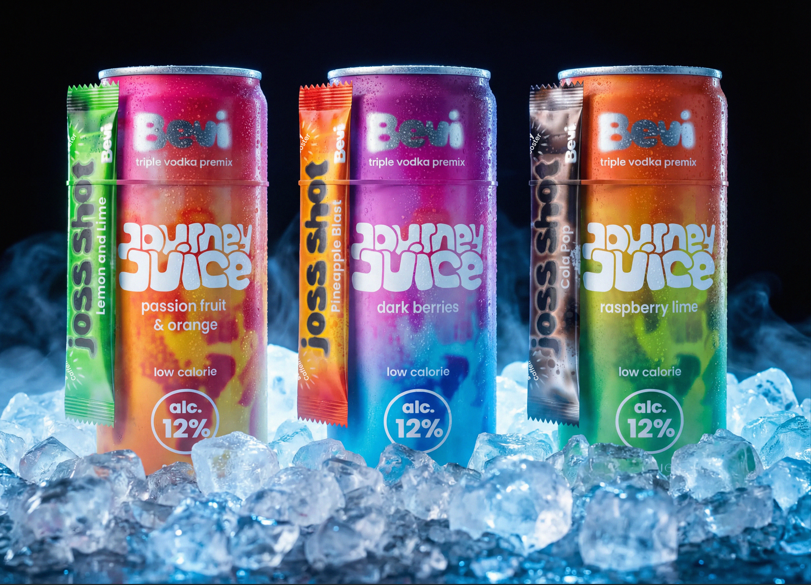
Our differentiation starts with format innovation. We've developed the SachetCan, a proprietary format that pairs our Journey Juice can with a Joss Shot sachet – a functional, fizzing, flavourful powder that transforms any alcoholic drink into an energy and vibe-boosting shot. This is a popular format in Southeast Asia, but we have made our own and are the first to bring this to the UK and beyond.
We have developed formulas that better meet the needs of our customers – 12% ABV with a triple vodka shot in every can, but low calories, real fruit and light carbonation to ensure we maintain a light, refreshing and fruity taste without being too sweet or heavy. We're not trying to be everything to everyone, and we're built specifically for the Gen Z pre-drinks occasion. That focus shapes every decision, from formulation to price point to packaging.

What key trends are you observing in the alcoholic beverage sector and how is Bevi responding to these?
The biggest trend we're watching is the narrative that Gen Z doesn't drink anymore, and we think it's being widely misread by the industry.
Our view is that Gen Z consumers drink plenty – they just don't drink brands they don't connect with, see as good value or that create friction to consume. We first noticed the popularity of Joss Shots in Southeast Asia party hostels amongst Gen Z, so we wanted to create Bevi to be the first to bring this trend across to the UK. We're also seeing a continued shift toward convenience and the pre-drinks occasion as a social event in its own right, rather than just a precursor to a night out, which we think has largely aligned with the current financial climate. Bevi is responding by building a brand that is genuinely native to Gen Z culture in how we communicate, what we stand for and the format of the product itself.
How have consumer drinking behaviours and attitudes toward alcohol evolved in recent years? How is this influencing your product development?
Drinking occasions have become more intentional. People are more conscious of what they're consuming – they want better value, and they're increasingly making the pre-drinks experience its own social event.
For example, we see people want functional drinks too, which is one of the reasons we created Bevi – not only a high-ABV drink great for before people head to bars or clubs, but also with the addition of the Joss Shot to bring the energy boost to enhance the pre-drink occasion.
At the same time, there's a real appetite for products that feel exciting and shareable without carrying the baggage of legacy alcohol brands. That's directly shaped our formulation approach as we’ve worked hard to achieve a great-tasting, low-calorie drink, which was one of the hardest technical challenges we faced. We went through several production runs before landing on the formula we have today, and getting that right was non-negotiable because taste and quality are the foundation on which everything else is built.
What ingredients are key to Bevi's range and why were they selected?
The Joss Shot sachet paired with our Journey Juice can is central to the Bevi experience. The format was inspired by the Joss Shot culture I encountered in Bali, which is a simple, sociable, high-energy ritual that translates perfectly to the pre-drinks occasion. On the formulation side, our focus has been on keeping sugar low without compromising on flavour. Every ingredient decision comes back to the same brief: great taste, genuine value and a format that feels exciting to share.
How does Bevi approach responsible marketing and encourage safe consumption while balancing commercial growth? What role do you believe alcohol brands should play in shaping responsible drinking behaviours?
We believe alcohol brands have a genuine responsibility here, and that responsible marketing and commercial success aren't in conflict but are complementary. Our target consumer is Gen Z, and that comes with a heightened duty of care. We'll always be transparent about units, we won't glamourise excess and we want Bevi to be associated with great social experiences rather than irresponsible ones.
We want to communicate responsible drinking with authenticity, embedding it into how we communicate rather than bolting it on as an afterthought. Getting the balance right as we scale is something we think about carefully.

Who do you see as your core consumer group?
Gen Z, specifically those who are actively engaged in social and nightlife culture. This is a generation that has grown up with Amazon, social media and direct-to-consumer brands, and they have very finely tuned instincts for what's authentic and what isn't. They want brands they genuinely connect with, that feel like they belong to their world rather than being marketed at them. What's exciting is that our early angel investors include around 18 Gen Z peers who put their own money in after tasting the product, and that kind of grassroots belief is the most powerful validation we could have.
Have you faced any significant operational or technical challenges on your journey so far? How have you navigated these?
Getting the formulation of the product right was particularly challenging. We worked with multiple development partners before finding our current partner, and the challenging process of creating a product that we would feel proud to sell was difficult.
The breakthrough came when we brought in a formulation consultant with impressive credentials, having worked on the Aldi and M&S ranges, who cracked the brief. The challenge of being able to develop the product, which ultimately is the most important thing about the brand, was a costly experience and one we didn’t foresee. This made us sharper and more resilient.
Beyond formulation, bringing the SachetCan format to market has thrown up its own set of engineering challenges. Getting the format shelf-ready meant solving problems we hadn’t solved before by sourcing custom-made bands with the right strength and durability to keep the sachet securely attached throughout the supply chain, and finding manufacturers willing and able to produce the format at scale. We've responded by investing in our own R&D and machinery, which not only gives us considerable control over quality.
What has been Bevi's greatest achievement to date?
It’s landing on a product we're genuinely proud of and building the brand from scratch. Getting to a sellable, scalable product was a long road with setbacks, so the moment we had stock, we were proud to put it in front of customers, which felt like a genuine milestone. Beyond the product itself, raising six figures on the strength of the vision and a taste test is something I'm proud of, too. It confirmed that what we're building resonates.
What's next for Bevi? Any expansion plans or new innovations in the pipeline?
The plan is to build a data-backed regional rollout blueprint and raise significant funds in the £500k–£1 million range to fuel it. In the near-term, we're targeting our first bullseye cash and carry listings in London ahead of summer, and we're developing partnerships to expand our reach in Gen Z culture. Longer term, the ambition is to be the number one Gen Z native pre-drinks brand in the UK and EU, and to scale our format innovation internationally.

What do you think the future will look like for the RTD alcoholic beverage category?
I think the RTD category is at an inflexion point. The brands that will win are those that genuinely understand the occasions and identities of their target consumers, rather than those chasing broad appeal. Format innovation will become increasingly important as the market matures, and consumers want something that feels new and made for them. I also think the pre-drinks occasion specifically is massively underserved and will grow significantly as a distinct category moment. The winners will be the brands that own a cultural position, not just a shelf position. Gen Z will increasingly dictate the direction of travel, and brands that aren't building genuine credibility with that audience now will find it very hard to catch up.
If you could offer one piece of advice to aspiring start-ups in the food and beverage industry, what would it be?
Find your founder-market fit before anything else. I learned this through years of launching brands on Amazon, which I could execute, but I wasn't building something I was truly passionate about. With Bevi, alcohol was the obvious answer: it sits at the intersection of what I know, love and have experienced. When you have that genuine connection to your market, you make better decisions and stay resilient through the hard stretches.


Related posts


