The latest news, trends, analysis, interviews and podcasts from the global food and beverage industry





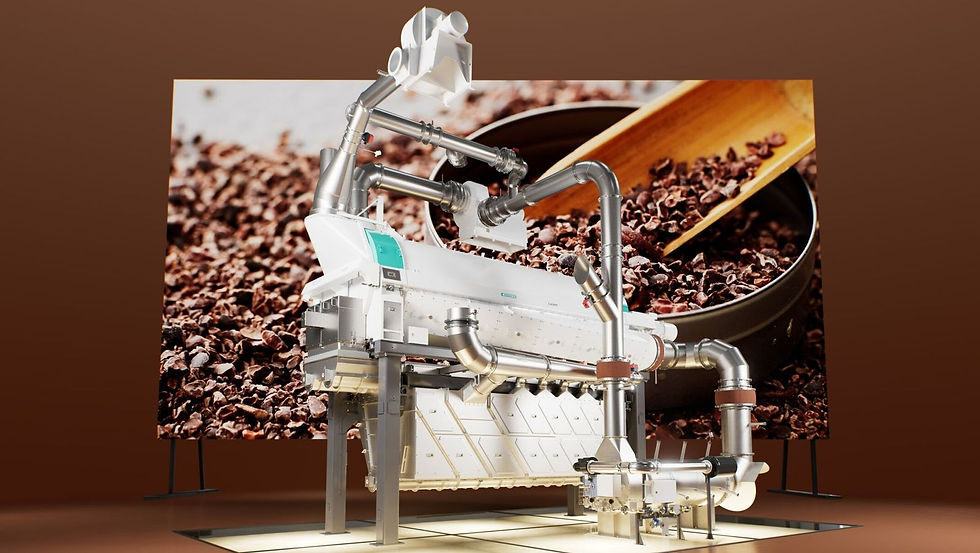
Bühler has developed Lucent, a new cocoa nib roaster designed to use at least 20% less energy per tonne of cocoa than its predecessor, with up to 20% higher throughput in the same footprint.
The machine combines heat recovery, predictive roasting controls and a fully sealed product chamber. Developed by Bühler's engineers and manufactured in Appenzell, Switzerland, Lucent aims to improve productivity, energy efficiency and food safety in cocoa processing, now available to industrial cocoa manufacturers worldwide.
With the industry under pressure due to volatile cocoa prices, rising energy costs and tightening margins, Bühler noted that energy is one of few input costs they can control directly. It accounts for 10-20% of total operating expenses in cocoa processing, with roasting as the most energy-intensive step.
Bühler’s previous Tornado roaster operates as a batch process in which hot air roasts the cocoa in a rotating drum and exhaust air is vented after each cycle, taking a significant share of thermal energy with it. The new roaster, Lucent, recovers that energy.
A heat exchange system uses return air, reducing the load on the gas burner. According to the company, the new machine’s redesigned drum geometry and optimised fill levels reduce gas consumption by at least 20% compared to Tornado, while increasing throughput by up to 20% without adding to the machine’s physical footprint.
Additionally, a hybrid roasting option, combining convective and conductive heat transfer, is available and can achieve up to 40% energy savings in specific applications.
Lucent features a fully enclosed roasting chamber and a new sealing system that physically separates the product from combustion air throughout the entire roasting cycle. It is made from stainless steel with an ‘easy-clean’ finish, and includes service openings to provide direct access to key components for reduced maintenance time and easy inspection.
Bühler noted that the design also reduces yield loss, a limitation in the previous generation of roasters where the product could be drawn into the airstream.
The technology’s self-learning control system continuously monitors key roasting parameters and automatically adjusts gas burner temperature, airflow and process speed. An operator sets a roasting profile and the algorithm manages execution, with roasting cycles running between 40-60 minutes depending on the raw material. The system adapts to variation in incoming cocoa to maintain consistent results from batch to batch. These controls aim to reduce dependency on specialist machine knowledge.
The development drew on feedback from Bühler's industrial cocoa processing customers, with the priorities identified directly influencing the design choices for efficiency, hygiene and operational simplicity. A prototype currently in development will be installed at a customer site in Asia during the first quarter of 2027, with further applications in roasting other commodities planned over the next two years.