The latest news, trends, analysis, interviews and podcasts from the global food and beverage industry




Most people rarely think about the processes, facilities and engineers that make the production of their favourite foods possible. Particularly underappreciated is the role of electric motors: the machines that help to pump, mix, chill, and shuttle the food and drink we consume daily. Yann Bottoli, global sales manager, ABB, explores these invisible workhorses humming away in the background of practically every industry, and how they shape successful F&B production.
While the role of electric motors generally is understood, what is even less acknowledged is the environmental toll these motors can carry. Food and beverage production ranks among the most energy- and resource-intensive industries, with food production alone responsible for an estimated 26% of global greenhouse gas emissions, according to Our World in Data.
Many F&B processes run on legacy direct-on-line (DOL) induction motors. These fixed-speed motors operate at full capacity and are adjusted by mechanical throttling or dampers. It’s a bit like driving a car with the accelerator floored and using the brake to control speed.
In the F&B sector, this issue hits even harder, with energy now ranking among the highest costs across the food supply chain. Processes such as beverage and dairy pumping, dough mixing and agitation and refrigeration or packaging compression are inherently highly dynamic, with loads that fluctuate continuously.
For a large plant, electricity demand can top hundreds of megawatt hours a month. Cutting consumption is therefore simultaneously an operational necessity and a sustainability lever. Major food producers are pursuing ambitious Scope 1 and 2 decarbonisation targets, and minimum motor efficiency regulations based on IEC standards continue to raise the bar on minimum motor efficiency. For manufacturers, sticking with legacy DOL motors risks higher compliance costs today, and inevitable upgrades tomorrow.
Control and quality work in unison
Variable Speed Drives (VSDs) deliver substantial energy savings by matching motor speed precisely to process demands, typically reducing power consumption by 25% or more in pumping, mixing and conveying applications. They allow smooth ramp-up and ramp-down sequences, sparing equipment from the jolt of sudden starts and stops. This reduced mechanical stress results in less wear on gearboxes and bearings, fewer breakdowns, and longer equipment life.
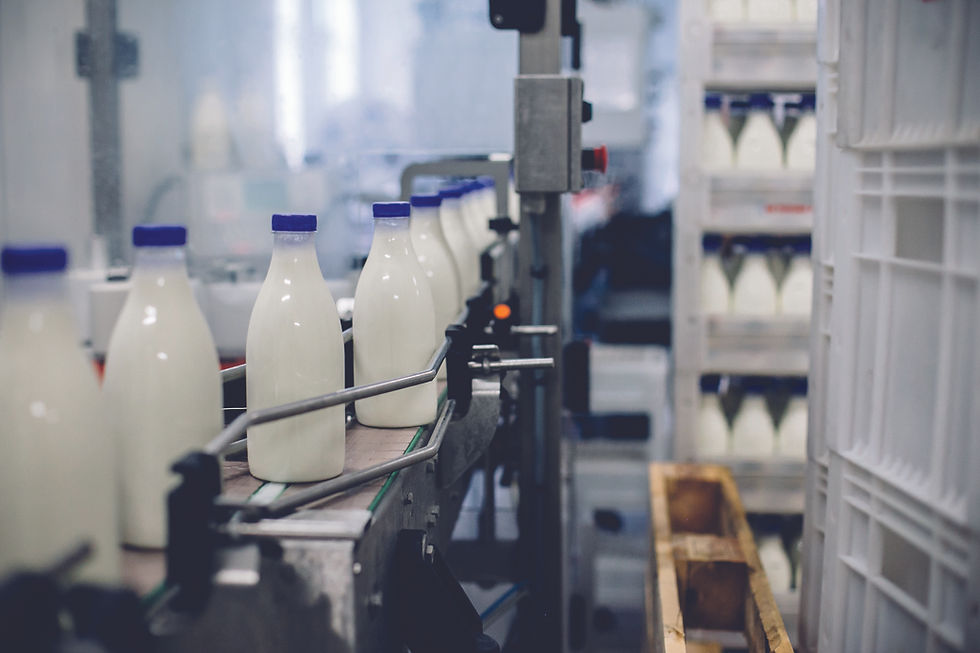
More critically for food production, precise motor speed control underpins consistent product quality. In dairies, gentle pump operation prevents foaming and protein denaturation. In bakeries, torque‑accurate mixing delivers consistent dough texture and batch uniformity. And on bottling lines, variable speed conveyors handle products more carefully during start‑ups and changeovers.
Packaging lines highlight the flaw of fixed speed: demand constantly shifts with container sizes, filling rates and pack formats. Yet traditional fixed-speed motors still operate at full power, wasting energy during standby or part‑load operation. That wasted energy is released as heat, while the motor racks up wear as if it were running under peak load, a sure recipe for premature fatigue.
So why aren’t VSDs everywhere by now? Despite being proven for decades, adoption lingers around 26% worldwide, even though roughly half of all industrial motors would benefit from speed control. The barrier isn't performance, but practicality. Traditional drives need external cabinets, extra wiring, installation downtime and expert commissioning. In hygiene-critical facilities with tight layouts and minimal tolerance for downtime, these complexities can be a dealbreaker. This is where variable speed motors (VSMs) offer a smart alternative.

Presenting the VSM
Inefficiency may be baked into much of the F&B sector, but the VSM offers an effective solution. Instead of treating motor and drive as separate components, VSMs unite them in a streamlined, single plug-and-play solution. With plug-and-play functionality, the motor and drive are commissioned and optimised to work together before leaving the factory, making installation fast and easy with no need for cabinets or electrical rooms.
These systems pair a permanent magnet motor with an axially integrated drive, enabling them to achieve the IEC’s IE5 ‘Ultra-Premium’ efficiency rating. An IE5 motor has 40% lower energy losses than commonly used IE3-level products. Paired with speed control, the motor only draws the power the process actually demands. For example, a typical 15 kW centrifugal pumping application in beverage or dairy facilities can save over €121,000 on electricity costs over a 15-year lifetime, with a lifetime avoidance of 174,000 kg in CO₂ emissions. Scale that across fleets of equipment and you're quickly uncorking savings worth millions of euros, with an equally substantial emissions reduction.
Variable speed also dovetails neatly with automation. Motors can dynamically adapt to viscosity changes or process stages, ensuring consistency without over-processing. Production agility gets easier, from recipe tweaks to line speed adjustments. VSMs are designed to complement this agility with compactness: up to three frame sizes smaller than equivalent induction motors, they cover power ranges from 1.1 to 30 kW, with rated speeds up to 4,500 rpm, making them suitable for pumps, agitators, compressors and conveyors. Their permanent magnet design delivers high power density and high efficiency over the entire speed range, with low-speed, high-torque operation ideal for viscous or stop-start processes.
A lever for change
F&B producers face several hurdles, including severe energy intensity, regulatory scrutiny, uncompromising hygiene standards, and relentless productivity demands. Given that motors are the single biggest users of electricity on the floor, they’re also the single biggest lever for change.
The variable speed motor shows what’s possible when efficiency and practicality converge: measurable drops in energy use and emissions, extended equipment lifetimes, and operational resilience. A fleet-wide rollout can deliver the scale that Scope 1 and 2 decarbonisation targets demand, while keeping operations cost-competitive.
Ultimately, investing in streamlined motor drive technology isn’t just a hardware upgrade, but a step change in the quest for sustainable food production.