The latest news, trends, analysis, interviews and podcasts from the global food and beverage industry




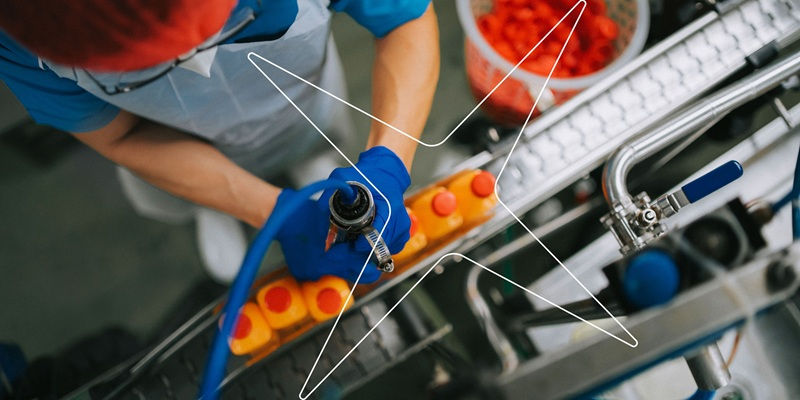
In most food and beverage plants, clean-in-place (CIP) sits in the hygiene column, with its own budget line, supplier and standards to hit. It rarely comes up in conversations about throughput.
That separation is an accounting convenience rather than an operational truth. Every hour a line spends washing is an hour it is not delivering. Across several lines running multiple cycles a day, the cumulative figure can be substantial, and it is almost never counted as lost capacity.
It goes uncounted partly because most CIP runs to a fixed cycle. The wash takes the same time whether the line has just produced something light or something heavy. Set conservatively, as it usually is, a fixed cycle is calibrated for the worst case and then applied to every case.
None of this is for want of monitoring. Temperature, chemical concentration, flow and time are recorded on every cycle, to a cadence set by each site’s SSOP. What those records do not do is change the wash. The parameters are set once and applied whether the line needs them or not. The good news is that this situation is changing, and it is worth addressing as a production question rather than a hygiene one.
Real-time monitoring now makes CIP performance visible across a plant, helping operators to track whether a wash conformed, what it consumed and where the exceptions are. Sensor-based soil measurement goes further, fine-tuning each wash to the actual load on the line rather than to a fixed set of parameters. In dairy trials, that approach has cut alkaline wash times by 10 to 20%.
Formulations are changing too. Enzymatic CIP cleaners offer a targeted alternative to caustic that removes several trade-offs processors have long accepted, including equipment wear, high sodium loads, and the effluent compliance burden that comes with them.
Individually, each of these solutions is an improvement. Together they point at something larger, which is that hygiene, food safety, water use and production capacity are not separate systems. They are one system, measured four different ways.
Most plants buy them separately. Cleaning from one supplier, water treatment from another, food safety from a third. That fragmentation carries a cost that rarely shows up on any single invoice. Decisions get optimised locally and traded off globally. A wash cycle is shortened in one place and a compliance risk appears in another, because the people making the first decision were not in the room for the second.
Ecolab’s holistic plant management approach is the alternative: one partner with visibility across cleaning, food safety, water and performance, and specialists who work inside the plant rather than around it.
The results show up in ordinary operational terms. Umpqua Dairy raised CIP wash conformance to 94% on average and saved more than $112,000 a year. Kraft Heinz cut wash time by 2,041 hours, worth $204,100. Neither is a hygiene outcome. Both are production outcomes that began with a cleaning decision.