The latest news, trends, analysis, interviews and podcasts from the global food and beverage industry




Ben Martin, founder and director of Royal Flush Creative, said consumers are becoming increasingly savvy about identifying 'manufactured authenticity, marketing obfuscation and AI-generated personality'. In this exclusive opinion piece for FoodBev, he asks what food and drink brands actually need to do to earn their trust.
‘Trust us.’ Two words almost guaranteed to make me wonder whether I should. Trust is one of those things every business wants to talk about, a bit like asking what makes a company different and hearing ‘the quality of our service and our people’. That's great, but unfortunately everyone else in the room just said the same thing.
You can't simply write ‘trusted since 1984’ on a packet, talk about your values on the website and expect consumers to believe you. In an increasingly cynical world, asking people to trust you can have precisely the opposite effect; trust has to be earned through what you actually do.
Usually, it's built from lots of surprisingly small things. The way you speak, how you handle a complaint, whether you listen, the claims you make, what the packaging implies, how transparent you are and whether the reality still matches the story when somebody looks a little closer. None of those things necessarily creates trust on its own, but collectively they start building a picture.
Principles: Easy when they're free
Most food and drink businesses I've worked with don't start out thinking: "How can we mislead everybody?" Quite the opposite. Founders often begin with strong principles around ingredients, sourcing, sustainability, packaging or how they want to treat customers – then they encounter the slightly inconvenient business of actually making things.
Time, budget and resources get involved. An ingredient becomes difficult to source, minimum order quantities become prohibitive, packaging lead times change or the economics simply stop working. The beautiful sustainable packaging you've specified might suddenly cost considerably more or take months longer to arrive; the ingredient you used when making 50 units in your kitchen might become a very different proposition when somebody asks you to manufacture 50,000.
Compromise doesn't automatically make a brand dishonest. Staying absolutely stoic about every decision until you've nobly gone out of business isn't particularly helpful either.
The more interesting question is which compromises you're prepared to make, why you're making them and whether they contradict something you've already asked your customers to believe about you. That's where trust starts getting tested.
Packaging as part of the evidence
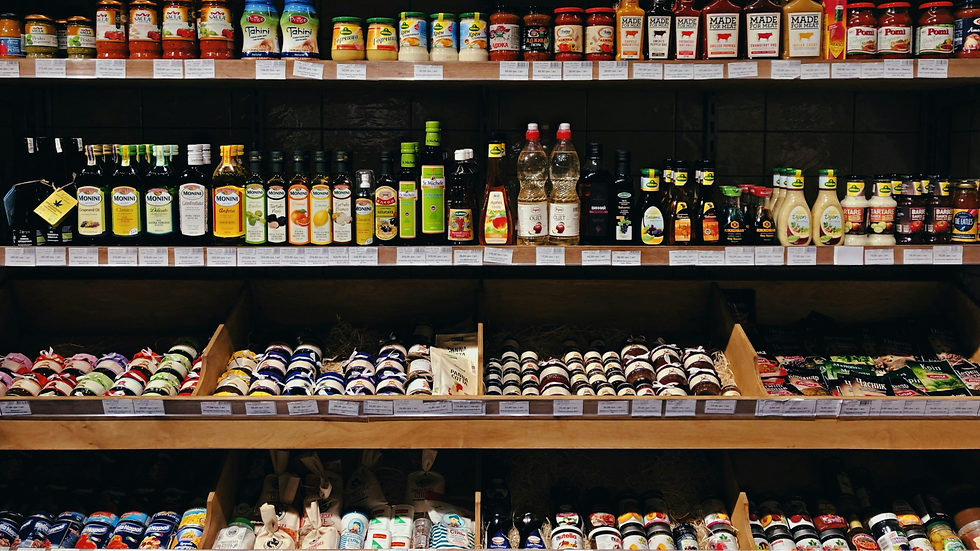
This is where branding and packaging can either help or make things considerably worse. Packaging communicates before anybody has read a word. Material, weight, colour, typography, photography, structure and finish all create expectations about what's inside; put something in a substantial glass jar where I can actually see the food, and I'm probably going to make different assumptions about it than I would if I found the same category of product hidden inside a cheap tin.

That doesn't automatically prove the product is better, but it tells me something about how you want me to perceive it – and if the quality inside supports that expectation, those signals start reinforcing one another.
The opposite is also true. If the pack looks like it was made on a farmhouse kitchen table, talks endlessly about craft and provenance and turns out to contain something that bears very little relationship to the world being presented on the front, the branding hasn't built trust – it's borrowed the visual language of trust.
There are only so many handwritten fonts, hand-drawn vegetables, muted colours and deliberately wonky labels the world needs before ‘authentic’ itself becomes a design convention.
Performed authenticity
This isn't really a new problem. There's a lovely thing about old recordings where you can sometimes hear the imperfections: a squeak, a noise in the room, something that wouldn't survive five minutes in a modern editing suite. It wasn't an authenticity strategy; it was simply what happened. Today, we can manufacture the imperfection.
We can add grain, scratches, scuffed corners and distressed type. We can make photography look less polished, social content look more spontaneous and carefully script a founder video to feel as though somebody happened to turn the camera on at exactly the right moment. Somewhere in the middle, authenticity becomes performance.
I don't think high production values are the problem. If you've got the resources to produce brilliant photography, film, packaging and design, great. Equally, if you're a founder with an iPhone, no marketing team and half an hour between production runs, genuinely lo-fi content can be incredibly engaging.
The dangerous bit is the massive grey area in between, where you're neither genuinely raw nor beautifully produced; you're adding scratches, wonky type and fake imperfections to prove how terribly authentic you are. People are getting very good at spotting it.
AI adds fuel to the fire
AI is accelerating the same problem, because sophisticated content production is suddenly available to almost everybody.
This is not an anti-AI argument. AI is here to stay, and we'd be daft not to use it; it can accelerate research, organise information, improve processes and help people work through ideas considerably faster. The problem starts when the tool replaces the thinking.
We've already learnt to recognise some of the hallmarks: the strange fingers disappeared, text in images improved, and now we're onto patterns in language, formatting, imagery and tone. The tells will keep changing because the technology will keep improving, but humans are pretty good pattern-recognition machines; once enough brands start sounding and looking the same, we notice.
If a founder uses AI to help organise their thoughts, does that make the resulting article inauthentic? I don't think so. If AI invents the opinion, writes the story and manufactures a personality that bears little resemblance to the founder, that's something very different.
We've had versions of this argument before. Photoshop made it possible to remove blemishes and manipulate bodies; stock photography let us construct scenes that never happened. Removing a plug socket from the background isn't the same as creating a product experience that doesn't exist, and AI hasn't invented that ethical line; it's just made crossing it much easier.
My rule of thumb is that the thinking should remain overwhelmingly human. If people notice the AI before they notice the idea, you've probably used too much of it.
Remaining human in a crisis
Trust becomes particularly visible when something goes wrong. KFC's famous ‘FCK’ response when it ran out of chicken in 2018 is probably overused as a crisis communications example by now, but there's a reason it keeps coming up. The brand couldn't hide what had happened, so it acknowledged the absurdity, apologised and sounded human rather than hiding behind carefully sanitised corporate language.

Sometimes, admitting you've made a mistake is considerably more trustworthy than 400 carefully lawyered words explaining why technically you haven't.
Brands are understandably frightened of criticism. We live in an age of screenshots, pile-ons and people waiting to catch somebody changing their story, so the instinct is often to reinforce the walls and say as little as possible.
But humans tend to respond to humanity. We understand mistakes, compromises and things not going according to plan because that's what being human looks like; what we're considerably less forgiving of is feeling that somebody is trying to wriggle out of responsibility.
Not everything valuable needs an immediate ROI
Then, somebody quite reasonably asks: "What's the return on all this?" This is where I get slightly nervous when creativity and brand building disappear into the land of the bean counters. That's not an attack on CFOs; they're supposed to understand where money is being spent and what the business gets back, and the good ones understand that when you get the return matters too.
The problem starts when every bit of brand investment is expected to behave like a performance marketing campaign. Trust takes time. Reputation takes time. Brand equity takes time. You can measure brand health, share of voice, sentiment, reviews, retention and repeat purchase, but if every individual activity has to produce an immediate attributable sale, eventually the easiest things to measure become the only things that get funded.
That's when brands start turning into commodities with marketing departments attached. Sometimes, the evidence is sitting in much more ordinary behaviour anyway. People buy you again. They recommend you. They'll pay a little more when there's a cheaper alternative next to you. They'll try the new thing you've launched because the last thing you sold them was good; and when something goes wrong, they might even give you the benefit of the doubt. That's commercial value, even if you can't always fit it neatly into this month's spreadsheet.
Start inside the business
So, if you actually want to build a trustworthy food or drink brand, I wouldn't start with the packaging, social calendar or advertising campaign. I'd start with the business.
Who are you there to serve? What do you genuinely believe? What are the permission-to-play values that somebody joining the team has to understand? Which promises are you actually prepared to make, and how are you going to prove them beyond writing ‘quality’ and ‘service’ on the About page?
Then work backwards from the customer. Understand the difference between features and benefits. Features are what you're selling; benefits are what your customers are receiving. Work out what problem you're solving or aspiration you're fulfilling, then make that easy to understand because, for all our increasing sophistication, convenience still wins an awful lot of the time.
That thinking should inform the packaging hierarchy, the visual identity, the language on the pack, how the customer service team responds, what you publish, which claims you make and the stories you choose to tell. A pack might only have seconds to do its job; if I have to turn it over and decode six paragraphs of brand philosophy before I understand what I'm buying, we've probably got the hierarchy wrong.
The brand isn't the logo, shop sign or packaging. It's the accumulation of all those interactions and, if there's a gap between what the organisation genuinely is and the version you've manufactured for the outside world, eventually somebody is going to find it.
You don't manufacture trust. You reveal the things that make you worthy of it. That's why I've always believed great brands aren't manufactured, they are revealed.
And perhaps that's the simplest definition of trust in the end. It isn't necessarily something you read; it's something you feel.

Related posts