The latest news, trends, analysis, interviews and podcasts from the global food and beverage industry

Search this site
11983 results found with an empty search
- AeroFarms acquired by Palm Ventures
Indoor vertical farming company AeroFarms has announced its acquisition by an affiliate of Palm Ventures, a family investment office with operations in Austin and Greenwich, US. The acquisition marks a significant milestone for AeroFarms as it seeks to strengthen its financial position and capitalise on growing consumer demand for nutrient-dense, sustainably produced foods. According to the company, the partnership substantially reduces AeroFarms' debt burden while prioritising long-term profitability, customer relationships and continued expansion of its microgreens portfolio. As part of the transition, Gustavo Burger has been appointed chief executive officer. Burger brings more than two decades of leadership experience in the food and beverage sector, including senior roles at Kraft Heinz and Anheuser-Busch InBev, where he led growth initiatives and operational performance across major retail and foodservice channels. In a statement, Burger said: "AeroFarms is built on the most advanced aeroponic platform in the food industry, a category-defining product, and retail partnerships with the best names in the business. My focus is to build on that foundation with the operational rigour it deserves, and create a business that performs as well as its products." Founder and chairman of Palm Ventures, Bradley Palmer, said: "Consumers are choosing foods that naturally pack higher nutritional value into every bite. AeroFarms is exactly the kind of mission-driven company we bring our intellectual, relational and financial capital to; a disciplined business with first-class retail customers, superior technology and a mission that matters." The investment firm also pointed to increased consumer interest in foods that support wellness and weight management goals, trends that have been amplified by the growing adoption of GLP-1 medications. AeroFarms, a Certified B Corporation, has established itself as a leading player in controlled environment agriculture through its patented aeroponics technology, automated systems and robotics-enabled production model. The company's indoor growing methods eliminate the need for soil and pesticides while using 90% less water and 230 times less land than conventional field agriculture, according to AeroFarms. The company says its microgreens contain significantly higher concentrations of select vitamins, minerals, and phytonutrients than their mature vegetable counterparts, depending on the variety. AeroFarms also cites an extended shelf life of 18 to 21 days for its products, compared with approximately one week for traditionally grown microgreens. Currently distributed in approximately 2,000 retail locations nationwide, AeroFarms enters its next phase with an emphasis on operational discipline and sustainable expansion. The transaction closed in April 2026, with financial terms undisclosed. Top image: © AeroFarms
- Vetropack unveils ‘Europe’s lightest’ Rhinewine bottle alongside new reusable variant
Vetropack has developed what it claims is the lightest Rhinewine bottle in Europe, alongside a reusable variant that supports the recently introduced reusable wine bottle system in Austria. The latest innovations from the glass packaging manufacturer aim to boost environmental sustainability in the Austrian wine industry. Vetropack’s latest development of the classic 750ml Rhinewine bottle significantly reduces its weight to just 350g while retaining the same dimensions. This reduced bottle weight lowers CO2 emissions throughout the supply chain, while also cutting material, logistics and licensing costs. This is particularly relevant for export markets with weight restrictions on glass packaging. The lightweight bottle is also made from around 80% recycled glass, Vetropack said, noting that regional production in Austria further improves its environmental footprint due to shortened transport routes. Compared with a traditional Rhinewine bottle, the bottle generates 33g, or 13%, less CO2 over a transport distance of 100km according to Vetropack. It is available in olive and cuvée, and retains the bottle’s familiar shape without compromising on functionality. Vetropack’s Harald Geist said: “Reducing the weight of a 750ml Rhine wine bottle to 350g is a significant technological achievement. The key was working closely with our technical teams to develop a solution that not only meets the mechanical requirements of our customers’ bottling and logistics processes but also delivers an attractive appearance.” Meanwhile, following a two-year development phase, a pooling scheme for reusable wine bottles is being launched in Austria, led by the Austrian Ecology Institute in collaboration with winegrowers and key stakeholders. Vetropack is already producing new returnable Rhinewine bottles at its Pöchlarn site. The olive-green bottle has been available to all businesses participating in the pool scheme since spring 2026. With a height of 340mm, the bottle is optimised for efficiency in logistics and can be stacked up to four layers high. A four-sided reusable embossing is designed to ensure the bottle remains clearly identifiable. The bottle is also the first reusable wine bottle with a BVS finish to be produced in Austria. This reinforced, specially developed neck ensures the robustness required for reusable cycles and industrial filling processes. The first market participants are already using the system, with Vetropack confirming the solution is also attracting interest in neighbouring countries. A matching six-pack crate is expected to be launched in July. Geist commented: “With the pool solution, winegrowers now have access for the first time to an elegantly designed, reusable wine bottle that is particularly well-suited to direct sales or use at green events”. “In addition to CO2 savings of up to 90% across the value chain, users also benefit from standardised processes, for example in cleaning and logistics.”
- Elopak introduces low-carbon aluminium in European carton production
Global packaging supplier Elopak has begun sourcing low-carbon aluminium produced using renewable electricity for its European carton manufacturing operations, marking a significant step in the company's efforts to reduce the environmental impact of its packaging portfolio. The low-carbon aluminium is now being incorporated into Elopak's standard ambient cartons produced at facilities in the Netherlands, Denmark and Ukraine. The transition delivers an immediate 8% reduction in the carbon footprint of the company's standard aluminium-based ambient cartons. According to cradle-to-gate calculations, the carbon footprint of a standard aseptic Pure-Pak carton has been reduced from 53g CO₂e to 49g CO₂e per carton following the switch. Emilie Olderskog, global head of sustainability at Elopak, said: "By sourcing aluminium produced with renewable electricity, we are taking another concrete step in reducing the climate impact of our packaging materials." Aluminium remains an important component in ambient carton packaging, providing an effective barrier against light and oxygen while enabling aseptic sealing. These characteristics help extend product shelf life and minimise food waste without the need for preservatives. "The introduction of low-carbon aluminium delivers an immediate and measurable reduction in the footprint of our standard ambient cartons, while allowing us to retain the functional properties that are critical for food protection and shelf life," Olderskog added. Alongside its standard carton range, Elopak offers Pure-Pak eSense, an aluminium-free aseptic carton designed for ambient distribution. The company says the solution can support further emissions reductions while enhancing recycling performance. Elopak also noted that it works exclusively with members of the Aluminium Stewardship Initiative (ASI), which promotes responsible aluminium sourcing and environmental performance standards throughout the value chain. The company continues to invest in material innovation and design improvements aimed at increasing the recyclability of its cartons. Across its global operations, including manufacturing sites and offices, Elopak operates using 100% renewable electricity. The company has also introduced cartons incorporating recycled polymers, an innovation launched in 2025 to help customers prepare for the European Union's upcoming Packaging and Packaging Waste Regulation (PPWR) requirements. As sustainability expectations from regulators, retailers and consumers continue to evolve, Elopak said it remains focused on strengthening the environmental performance of its packaging portfolio through lower-emission materials, efficient resource use and improved recyclability. Founded in Norway in 1957, Elopak supplies paper-based packaging solutions under the Pure-Pak, D-PAK and Roll Fed brands, alongside filling machines and related services. The company operates in more than 70 countries, employs over 3,000 people worldwide, and has established Science-Based Targets aligned with a 1.5°C emissions reduction pathway for Scope 1 and 2 emissions, alongside a net-zero commitment by 2050.
- UK approves Wegovy GLP-1 oral tablets for weight management
The UK has become the first country in Europe to approve Novo Nordisk’s Wegovy semaglutide tablet for weight management, a move expected to increase GLP-1 medication use and continue to reshape UK consumers’ grocery spending behaviours. The GLP-1 receptor agonist tablet was approved on 11 June 2026 by the Medicines and Healthcare products Regulatory Agency (MHRA). It provides an oral alternative to injectable GLP-1 medications, the use of which has risen rapidly across global markets in recent years. New research shows that in the UK, adoption of GLP-1 drugs has nearly tripled in two years. An estimated 1.9 million adults in the UK are estimated to be currently taking the mediations for weight management, according to recent data from Worldpanel by Numerator. The analysis highlighted the impact on the food and beverage industry, with GLP-1 user households found to have spent £780 million less on groceries overall during the study period. Categories such as snacking are seeing particular impact, with chocolate confectionery expenditure declining 18% more among GLP-1 users than among non-user households. Meanwhile, 72% of the users reported reducing crisp purchases. GLP-1 (glucagon-like peptide-1) receptor agonists work by mimicking the body’s natural GLP-1 hormone, which helps to regulate blood sugar and has appetite suppressing effects. They were primarily introduced to treat type 2 diabetes, and in recent years their use for weight management has soared – particularly in the US, where data suggests around 12% of adults have taken them for this purpose. UK adults who have a Body Mass Index (BMI) of 30 or above, or between 27 and 30 with at least one weight-related comorbidity, may now be prescribed the drugs in pill format rather than the previously available injectables. While approved in the UK, the tablets are currently only available via private prescription and not through the National Health Service. In a recent industry roundtable published in FoodBev magazine, Annabel Twinberrow, analyst at Agriculture and Horticulture Development Board (AHDB), noted the expectation that uptake of the medications in the UK will increase as oral options become available – only 14% of people surveyed by IGD in January 2026 said they would try injections, she pointed out. “With the current evidence, we can expect that uptake in the UK will continue to increase as policy shifts, accessibility increases and new variants of the drug emerge,” she said. Mike Hughes, head of research and insight at FMCG Gurus, said this will create an opportunity for the F&B industry to develop products that cater to demand for more nutrient-dense, lower-calorie diets, as well as those that can help manage side effects. This is a key focus area for many companies innovating in the nutraceutical space, as FoodBev discovered at the Vitafoods Europe 2026 event. “While these opportunities exist, brands must proceed in an ethical manner: remember that this is a medical nutrition product, rather than a mass market offering,” Hughes said. “Brands shouldn’t be seen to be encouraging people to use such medication unnecessarily as a quick fix solution.”
- Amano Enzyme showcases pea protein processing technology at Bridge2Food Europe
Amano Enzyme showcased its ProBoost Neutra enzyme solution for pea protein processing at Bridge2Food Europe 2026, highlighting its potential to improve functionality, flavour and production efficiency in plant-based food applications. The company presented the technology during a session titled 'Enzyme Powered Pea Innovation', delivered by Antonio Sullo, head of research and development for Amano Enzyme Europe, as part of the event's Product Development & Processing track. ProBoost Neutra has been developed to address common formulation challenges associated with pea protein, including solubility, emulsification and flavour. According to Amano Enzyme, the solution improves the solubility and emulsification properties of pea protein isolate while maintaining protein content. The company also said the technology delivers a lighter taste profile with reduced off-notes, helping manufacturers develop more appealing plant-based products. Designed for use within existing wet fractionation systems, ProBoost Neutra can be integrated into current production lines without significant capital investment or major process modifications. Amano added that the solution supports cleaner processing by replacing the alkaline step in existing wet fractionation processes. "Pea protein continues to play a critical role in the evolution of plant-based foods, but manufacturers still face many challenges when it comes to taste, texture and processing performance," said Sullo. "ProBoost Neutra was developed to help overcome these barriers and unlock new opportunities for product innovation and success with today's consumer." During the presentation, Sullo also highlighted several enzyme technologies designed to improve the valorisation of pea-based ingredients and support more sustainable production processes. Application examples included increasing protein content in pea protein cheeses and converting pea starch fractions into low-sugar syrups. According to Amano Enzyme, ProBoost Neutra is non-GM and suitable for organic-compliant formulations. The company said key benefits include improved solubility and emulsification, a milder flavour profile, maintained protein content and implementation without significant capital expenditure requirements.
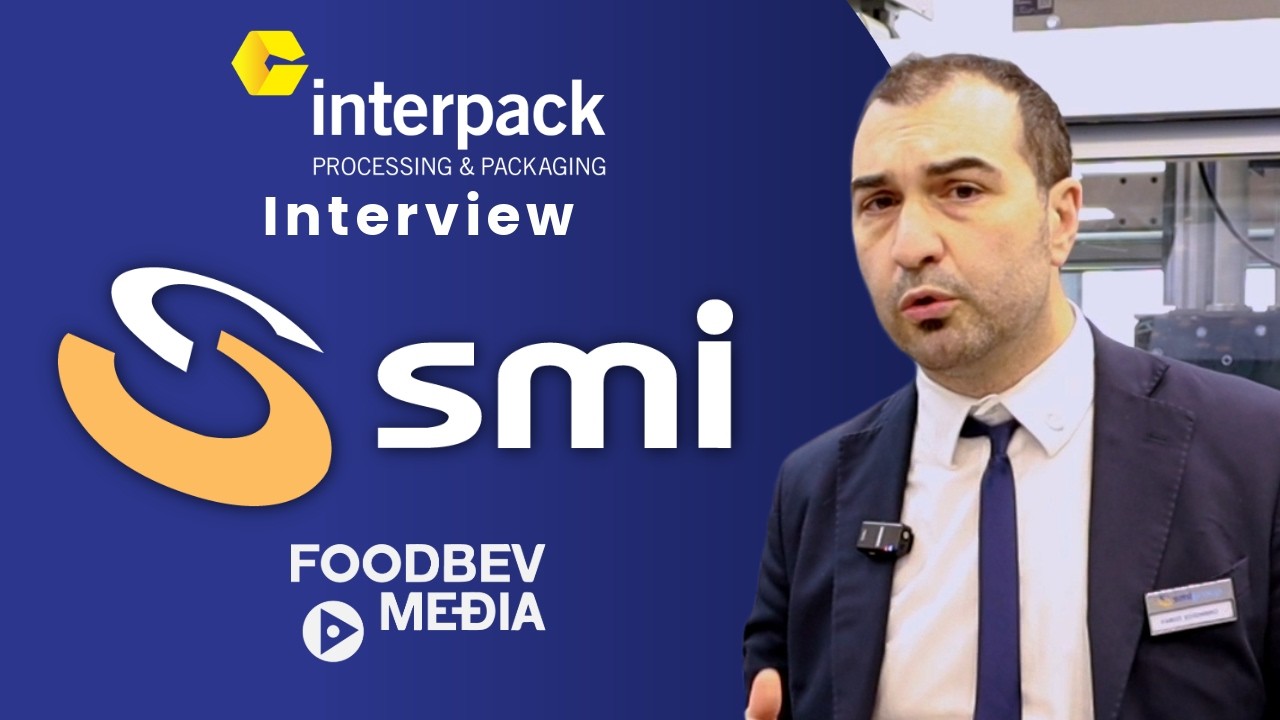
- SMI’s latest packaging innovations revealed at Interpack 2026
At the Interpack 2026 trade show in Düsseldorf, Germany, FoodBev Media caught up with SMI’s sales director, Fabio Sisimbro, to chat about the company’s recent innovations in food and beverage packaging technology. Among the innovations showcased at the event was the SFP 30 stretch-film packer machine, highlighting how the solution can help manufacturers to achieve savings across energy, materials and costs compared to shrink film packaging applications. It also highlighted its PET bottle production capabilities, demonstrating its expertise in blow-moulding lightweight bottles, designing for recyclability, and offering bespoke bottle customisation solutions. Other solutions include its Kraft cardboard secondary packaging technologies, enabling significant material reductions, while its shrink-film packaging capabilities highlighted quality and efficiency for multi-pack beverage products. Watch the full video above to find out more.
- JAB completes exit from Keurig Dr Pepper with sale of remaining 4.3% stake
JAB BevCo, a subsidiary of investment firm JAB Holding Company, has sold its remaining stake in Keurig Dr Pepper (KDP) following the beverage giant's JDE Peet's acquisition and planned separation. JAB's remaining stake consisted of approximately 59.1 million shares, or around 4.3% of the company's outstanding common stock. The shares were sold through an unregistered block trade managed by JP Morgan Securities. This transaction completes JAB's exit from Keurig Dr Pepper. In May 2025, the investment firm sold 75 million KDP shares in a transaction worth approximately $2.51 billion, reducing its holding to around 4.4% of the company's outstanding common stock. JAB has now sold that remaining stake, which had a market value of approximately $1.85 billion based on KDP's share price at the time of the announcement. Keurig Dr Pepper was formed in 2018 through the merger of Keurig Green Mountain and Dr Pepper Snapple Group. JAB played a key role in the creation of the business and had remained one of its major shareholders in the years since the merger. Last year, KDP announced its acquisition of coffee giant JDE Peet's for €15.7 billion, with plans to separate into two US-listed public companies: Global Coffee Co and Beverage Co. JAB said it remains committed to its consumer investment platform and will continue to focus on building consumer businesses through long-term investment. The company added that recent senior appointments have strengthened its team as it pursues opportunities across the consumer sector.
- Exchange For Change unveils £60m retailer support package for DRS rollout
Exchange For Change, the organisation responsible for delivering the UK's forthcoming Deposit Return Scheme (DRS), has announced a new package of retailer support measures, including expanded exemption criteria and £60 million in grant funding, ahead of the scheme's planned launch in October 2027. The measures are designed to help retailers prepare for the introduction of the DRS across England, Scotland and Northern Ireland, under which consumers will pay a refundable deposit on eligible drinks containers. Under existing regulations, retailers in urban areas with a retail footprint of less than 100 square metres are automatically exempt from operating a return point for DRS containers. Exchange For Change has now secured agreement from regulators in all three nations to broaden the exemption criteria. The changes will allow urban retailers with a sales area of between 100 square metres and 199 square metres, as well as rural retailers with less than 200 square metres of sales space, to apply for a size-based exemption. Additional exemptions may also be granted where factors such as proximity to another return point, heritage or listed building restrictions, site access limitations or a lack of utilities make participation difficult. Alongside the expanded exemptions, Exchange For Change has committed £60 million in grant funding to support the installation of Reverse Vending Machines (RVMs) at up to 10,000 small independent retail sites across England, Scotland and Northern Ireland. Eligible retailers will be able to access grants worth £6,000 per site, paid in three annual instalments of £2,000 following the installation of an RVM. According to Exchange For Change, the funding is intended to help smaller retailers manage the costs associated with participating in the scheme and operating automated return points. Russell Davies, CEO of Exchange For Change, said: "Retailers will play a fundamental role in transforming how we increase recycling and reduce litter in every corner of the UK through the Deposit Return Scheme". "This package of support has been developed following extensive consultation with industry and intended to help retailers of different sizes make the best choice for their business, whether that's installing an RVM or applying for an exemption." "Together with the Return Handling Fee, the extension to exemptions and the provision of grants for small, independent retailers is another significant milestone in our work to deliver a scheme that is fair for business and accessible and easy to use for all consumers." The announcement follows the publication of the scheme's Return Handling Fee (RHF) structure last week. Under the framework, manual return points will receive 3p per container returned, while automated return points will be compensated according to annual return volumes. Retailers operating automated return points will receive 5p per container for up to 225,000 eligible containers returned annually. Returns above that threshold will attract a fee of 1.3p per container. The RHF is intended to help retailers recover costs associated with collecting and storing returned containers, including equipment purchases, staff training and the use of retail floor space. Exchange For Change said the expanded exemption criteria are intended to provide greater flexibility for retailers while ensuring sufficient local return point coverage for consumers. The organisation will be responsible for assessing and approving exemption applications. While grocery retailers with more than 200 square metres of retail space will still be able to apply for exemptions, the new framework maintains a presumption against granting exemptions to stores of that size or larger. Further details on grant eligibility and the exemption application process are expected to be published during the third quarter of 2026.
- Ayana Bio and Brevel partner on plant-based bioactive ingredient production
US-based plant cell technology company Ayana Bio has entered a strategic development partnership with Israeli fermentation specialist Brevel to advance the commercial production of plant-based bioactive ingredients. The collaboration has been selected for funding by the Israel-US Binational Industrial Research and Development (BIRD) Foundation, which supports joint innovation projects between American and Israeli companies. The project forms part of a newly approved group of seven initiatives backed by a $7.5 million grant programme designed to accelerate the commercialisation of emerging technologies. Under the partnership, Ayana Bio and Brevel will combine their respective plant cell cultivation and illuminated fermentation technologies to develop a scalable indoor production platform for high-value bioactive ingredients. The companies said the collaboration aims to address challenges associated with conventional botanical ingredient supply chains, which can be affected by climate change, agricultural variability and contamination risks. Ayana Bio will contribute its plant cell cultivation and synthetic biology capabilities, while Brevel will provide its proprietary illuminated fermentation platform, which is designed for the commercial-scale cultivation of photosynthetic organisms. Frank Jaksch, CEO of Ayana Bio, said: "Our mission at Ayana Bio is to democratise nature's bioactives by decoupling ingredient production from traditional agricultural constraints. By integrating Brevel's unique illuminated fermentation platform, we can further scale our plant cell lines in a controlled, highly efficient environment." Jaksch added that the BIRD Foundation grant supports the development of standardised, contaminant-free plant ingredients for the nutrition and wellness sectors. Yonatan Golan, CEO and co-founder of Brevel, said the collaboration would expand the potential applications of illuminated fermentation technology. "Applying this hardware and process engineering to plant cell cultivation allows us to accelerate the transition to a more resilient, sustainable food system," he said. The BIRD Foundation said the project reflects its objective of supporting collaborative innovation between US and Israeli companies. According to the organisation, the latest funding round is expected to leverage private-sector investment and contribute to a combined $20 million in project funding. The companies said the technology could support the production of ingredients for consumer packaged goods, dietary supplements and functional food applications. Top image: © Ayana Bio
- ABB targets harsh food processing environments with new ACS580 drives
Industrial technology company ABB has expanded its ACS580 drive range with new IP66 and UL Type 4X-rated variants designed for use in demanding food, beverage and agricultural environments. The new additions to ABB's all-compatible drives portfolio are engineered to withstand regular washdowns, hose rinsing, humidity, dust, splashing and exposure to common cleaning agents, allowing them to operate without the need for additional protective enclosures. According to ABB, the drives have been developed to meet growing demand for motor control systems that can perform reliably in hygiene-sensitive and harsh operating environments while helping to reduce installation complexity, system footprint and overall ownership costs. The ACS580 IP66 and UL Type 4X drives are intended for use across a range of applications, including dairy processing, meat and poultry production, bakeries, livestock facilities and aquaculture operations. Brith Isaksson, global segment manager for food and beverage at ABB Motion, said: "Food and beverage producers need equipment that can perform reliably in areas where moisture, cleaning routines and demanding hygiene requirements are part of everyday operation." "With the new ACS580 IP66 / UL Type 4X variants, we are making efficient motor control easier to install closer to the process, helping customers reduce complexity while maintaining reliable performance in tough conditions." The drives also feature an optional Bluetooth-enabled control panel, allowing users to carry out remote commissioning and monitoring through ABB's Drivetune and Drive Composer applications. ABB said the functionality can help personnel remain outside the arc flash boundary during operation. Additional features include an optimised DC choke, a built-in C2 electromagnetic compatibility (EMC) filter and two option slots for fieldbus adapters and additional input/output modules, enabling system integrators to tailor connectivity to specific application requirements. ABB said the launch broadens the environmental protection options available within the ACS580 drive family, with the new variants offered across a range of power ratings to support multiple industrial applications.
- Frida Redknapp launches whole food convenience brand Frood
Frood, a whole-food food brand founded by Swedish-born entrepreneur Frida Redknapp, launched earlier this month exclusively in M&S and Ocado. The range features four nutrient-rich cooking blends aimed at consumers seeking healthier meal solutions without compromising on convenience. The initial line-up comprises Swedish Meatballs, Bella Bolognese, Golden Curry and Mexi Fiesta, each developed to help consumers prepare wholesome meals with minimal effort. Retailing at £3 per 75g pack, each blend serves 4 people and can be prepared in around 20 minutes by simply adding a chosen protein. Positioning itself around the concept of ‘convenience without compromise’, Frood aims to create a new category within ambient meal solutions by offering products that are UPF free, contain no added sugar, no flavourings or colours and are produced without heat or oil processing. Each blend combines gently dried fruits and vegetables, grains, seeds and plant proteins, delivering the equivalent of 560g of raw vegetables per pack. The products are also naturally rich in fibre and a source of protein, aligning with growing demands for minimally processed, nutritionally balanced meal options. Founder Frida Redknapp said: “I came up with the idea when I realised that consumers were searching for something that quite simply didn’t exist. In a space between packet mixes, meats and herbs, there were no healthy convenience options.” Alex Lo, buyer for cooking essentials at Ocado, said: “In a world where everyone is increasingly time poor and health conscious, Frood offers a fun and convenient way to assemble your favourite dishes.” Frood is available now in four variants, priced at £3 per pack.
- Tenzing expands functional energy range with White Peach flavour
Tenzing is expanding its fast-growing Natural Energy+ platform with the launch of Natural Energy +Focus White Peach, a functional energy drink designed to support concentration and sustained mental performance. The launch marks the second addition to Tenzing’s Natural Energy+ range, following the launch of Natural Energy+ Lion’s Mane earlier this year. According to the brand, the Lion’s Mane product has recorded 48% month on month growth since its debut in March. Developed to support focus and concentration, the new drink combines 160mg of natural caffeine with L-theanine in a 1:1 ratio, a formulation recognised for promoting alertness without jitters or the energy crash commonly associated with traditional energy drinks. The product features a triple tea blend of matcha, white tea and green tea, providing both a natural source of caffeine and L-theanine while contributing to a lighter, tea-inspired flavour profile. Additional functional ingredients include Sakura extract, derived from Japanese cherry blossom, and magnesium. Huib van Bockel, founder of Tenzing, said: "We've seen strong success since we launched Natural Energy+ earlier this year, to answer the demands of the next generation who want more from their energy drinks. Building on what Tenzing is known for – good energy that's 100% from nature, low calorie, with no crash – the new White Peach variant is built for focus, when you need to do deep, concentrated work." Founded in 2016, Tenzing was inspired by traditional Himalayan brews consumed by Sherpas, including mountaineer Tenzing Norgay. The brand is now stocked across all major UK retailers, with the Natural Energy + Focus White Peach available via their website and launching on Amazon next month. The product will also be available to the convenience and specialist retail channels through selected wholesalers.